Lux Aeterna
  • Home
  • How to Play
  • Setting
    • AfterLight
    • Belhaven
  • Character Creation
    • Species
    • Backgrounds
    • Assets
    • Features
    • Foils
    • Class >
      • The Berserker
      • The Cantor
      • The Dread
      • The Engineer
      • The Esper
      • The Exorcist
      • The Hallowed
      • The Hunter
      • The Magus
      • The Monk
      • The Occultist
      • The Sage
      • The Scoundrel
      • The Verdant
      • The Warrior
  • Adventure
    • Arms and Equipment

Movement

Every character has a stat called Speed which indicates how many meters they may move when using an Action to do so (on a grid, Speed indicates how many spaces a character may enter during a move Action). This kind of Action is called a Movement. During a movement, you...
  • Can move horizontally or diagonally in any direction but only 1 meter at a time vertically by jumping (from a viable surface at any point during  your move).
  • Can move through spaces occupied by allies, but can't end a Movement in an occupied space.
  • Cannot move through spaces occupied by enemies or solid objects/obstacles.
  • Can jump, roll, slide, or perform some kind of athletic maneuver at any point during the movement but for no more than 2 consecutive meters of the movement's total meters (a Brawn or Skill Feat may be required for especially fancy or difficult maneuvers).
  • May stop moving at any point; you do not have to move your full Speed during a Movement. Once you stop moving, however, you can't start moving again unless you use another Action to do so (you are able to perform any Free Action you're capable of while moving however).

Rough Terrain

Some terrain such as knee-high water, mud, sand, and loose gravel can be difficult to move through. This Rough Terrain slows down anyone who moves through it. A space of Rough Terrain counts as 2 meters of Movement instead of 1 (though if your Speed is 1, you can ignore this and move through Rough Terrain normally).

OTHER MODES OF MOVEMENT

Swim: In an aquatic environment, a character may move in 3 dimensions. Unless specifically adapted to aquatic environs, swimmers must treat the water they're swimming in as Rough Terrain and provide Advantage to those who attack from dry ground. Additionally, while swimming underwater, you'll have to hold your breath.

Jump: You can jump 1 meter vertically or 2 meters horizontally as a part of any Movement you make (with a Feat if necessary). Some special abilities will allow you to jump much higher and farther. While jumping in this manner, you can move however many meters vertically and/or horizontally the ability allows you to, but must end the Movement on solid ground.

Climb: With a roll +Brawn, you may climb almost any surface. This roll is required each time you move via climbing and failure causes you to fall to the ground. A climbing creature moves at half Speed (to a minimum of 1) and provides Advantage to attackers who are not climbing. The Difficulty of this Feat depends on the surface: 
  • Difficulty 1: Plenty to grip, many footholds (a tree, house, or rocky outcropping)
  • Difficulty 2: Not much to grip, few footholds (a brick building or sheer cliff-face)
  • Difficulty 3: Sheer surface with almost no footholds (glass building or smooth wall)

SPECIAL MOVEMENT

The following types of movement are not normally possible for Mortals without magical or supernatural means. These types of movement are normally followed by parenthesis indicating the Speed one has when traveling this way. For example, Fly (5) indicates that for every Action spent flying, the character can fly 5 meters. There are certain considerations to take into account for each of these modes of movement: 
  • Fly: You may move in any direction, even vertically and may end movements airborne while able to fly.
  • Glide: You automatically move horizontally as you fall, at a rate of 5 meters (diagonally downwards in a direction of your choosing) when your turn starts. If you're still gliding by the time you reach the ground, you don't take any damage from falling.
  • Hover: You float just 1 meter above the ground, avoiding land-based obstacles, hazards, and Rough Terrain.
  • Jump: While you can normally only jump 1 meter vertically or 2 meters horizontally while moving, this special type of movement allows you to leap skywards for the duration of the movement, but you must end the move by landing on a viable surface and cannot remain airborne when the movement ends (otherwise you crash to the ground).
  • Teleport: You instantly appear in any space (within range of the teleport) which you have Line of Sight to.

FORCED MOVEMENT

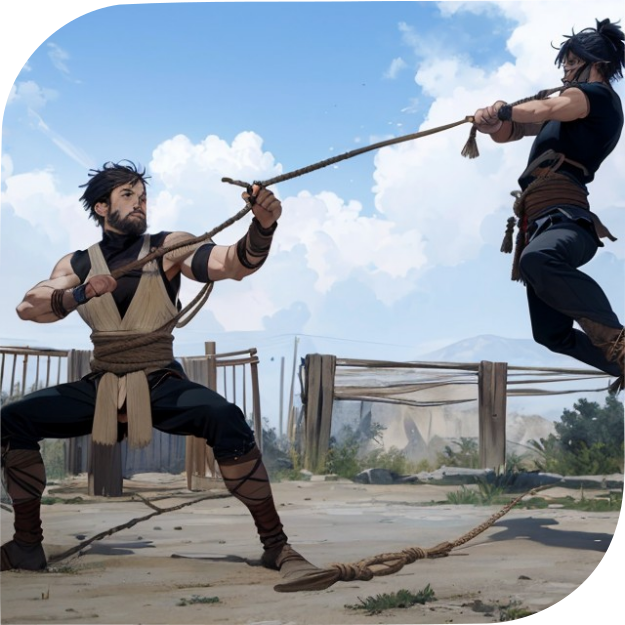
Occasionally, a creature may be forced to move by another creature or an outside force. This is referred to as Forced Movement.
There are three types of Forced Movement:

PUSH

Picture
A pushed creature moves away from the force that is moving them. No matter what direction they move, they must end the movement further from the pusher than they started and can, at no point during the movement, be brought closer to the pusher.

PULL

Picture
A pulled creature moves towards the force that is moving them and must end their movement closer to the pulling force. At no point in the movement can they be moved further from the pulling force.

SLIDE

Picture
A creature that is slid can be moved in any direction by the forced movement.
If a creature subjected to Forced Movement would be moved into a hazard or a trap they're aware of, they may Save as a Reaction. Success ends the Forced Movement and the pushed/pulled/slid creature falls prone just shy of the hazard.

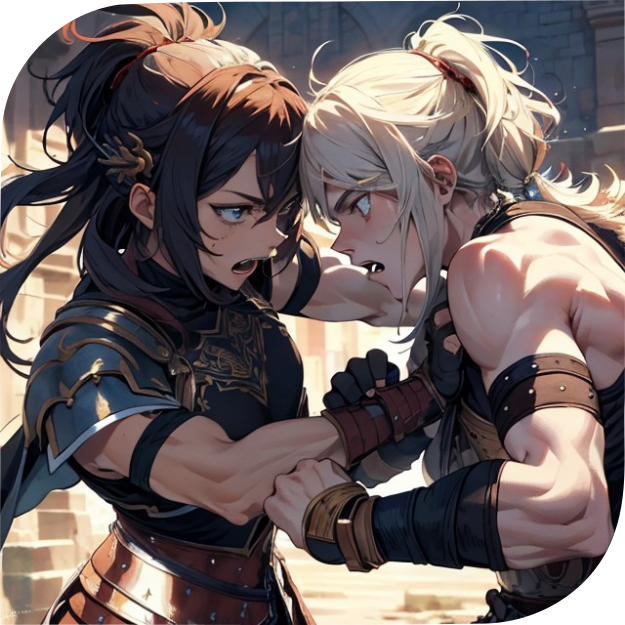
GRAPPLING

There are several actions that can be taken by any creature to forcefully move another creature that is their size or smaller:

sHOVE

Picture
To shove a creature is to move them while you remain stationary.

​Attacker and defender both make a Brawn Feat. The attacker pushes the target 1 meter for every Bumps rolled over the defender's total (up to a maximum distance equal to the attacker's Brawn).

dRAG

Picture
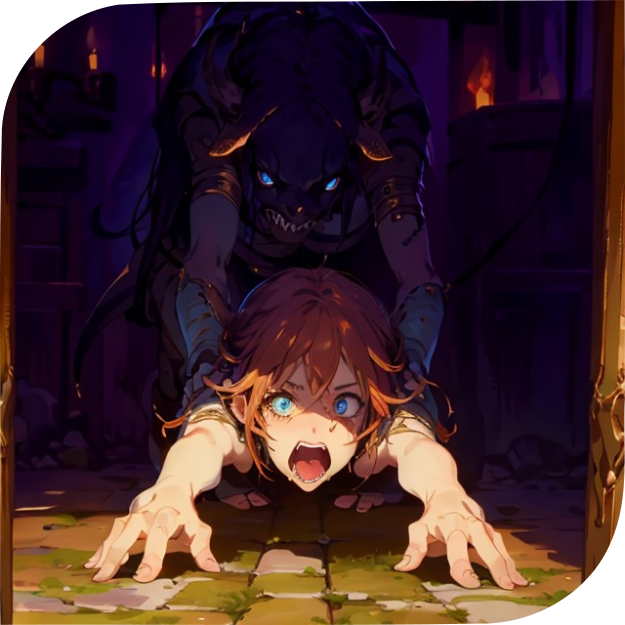
A creature you drag continues to move as you enter the space they vacate.

​Attacker and defender both make a Brawn Feat. If the attacker rolls more Bumps than the defender, the attacker may drag the defender up to half their Speed, forcing them into every space they vacate.

gRAB

Picture
Attacker and defender both make a Brawn Feat; if the attacker wins out, the defender is grabbed (the Difficulty to escape the grab is equal to the difference between the total Bumps rolled by the attacker and the defender).

If grabber and grabbee are the same size, both are Immobilized for the duration of the grab. Otherwise, the grabbee is pulled along whenever the grabber moves.


Unless otherwise noted, a creature can only perform one grab at a time.

Falling

When a character falls 5 or more meters, there is a risk of sustaining serious (if not fatal) injury. For every 5 meters a character falls, roll a d6 and consult the chart below:
  •  If you fall into soft, yielding ground (mud, sand, hay, etc.), you may opt out of one roll. 
  • If you fall into liquid, you may opt out of three rolls.
  • You may attempt a Skill Feat as a Reaction to land well or reduce your falling speed. You may opt out of one falling damage roll for every 2 Bumps you get.

How Fast do I Fall?

When you spend your entire turn falling at normal speed, you'll fall a total distance of 20 meters. If you reach the ground before falling 20 meters (and are still alive, conscious, and able to take a turn), you'll have this much of your turn remaining: 
  • 1-5 meter fall: 3/4 of your total Actions remaining
  • 6-10 meter fall: 1/2 of your total Actions remaining
  • 11-15 meter fall: 1/4 of your total Actions remaining
  • 16-20 meter fall: none of your Actions remaining
ROLL
RESULT
1
Instant death
2
Gain a permanent Health & StatusTrauma of the GM's choosing
3
Suffer a Trauma of the GM's choosing
4
Take 1d10 Physical damage for every 5 meters you fell before hitting the ground
5
Take 1d6 Physical damage for every 5 meters you fell before hitting the ground
6
Land Prone with no ill effect

HOME

HOW TO PLAY

SETTING

CHARACTER

ADVENTURE

Copyright © 2023
  • Home
  • How to Play
  • Setting
    • AfterLight
    • Belhaven
  • Character Creation
    • Species
    • Backgrounds
    • Assets
    • Features
    • Foils
    • Class >
      • The Berserker
      • The Cantor
      • The Dread
      • The Engineer
      • The Esper
      • The Exorcist
      • The Hallowed
      • The Hunter
      • The Magus
      • The Monk
      • The Occultist
      • The Sage
      • The Scoundrel
      • The Verdant
      • The Warrior
  • Adventure
    • Arms and Equipment