Lux Aeterna
  • Home
  • How to Play
  • Setting
    • AfterLight
    • Belhaven
  • Character Creation
    • Species
    • Backgrounds
    • Assets
    • Features
    • Foils
    • Class >
      • The Berserker
      • The Cantor
      • The Dread
      • The Engineer
      • The Esper
      • The Exorcist
      • The Hallowed
      • The Hunter
      • The Magus
      • The Monk
      • The Occultist
      • The Sage
      • The Scoundrel
      • The Verdant
      • The Warrior
  • Adventure
    • Arms and Equipment

Health & Status

The many dangers of the adventuring lifestyle can take their toll on even the most stalwart of heroes. No matter their strength, every character is subject to injury and fatigue. This section lists the many ways in which a character can be hurt as well as the many ways those hurts can be healed.
​

Hit Points

An assassin's dagger finds its mark. A trap in the underbrush catches the hero unawares. A tumble down a rocky cliff inflicts some serious injury. At some point in their adventures, every hero is bound to take Damage; the loss of Hit Points.

Hit Points are a gaming abstraction that represent how close a character is to death. Losing Hit Points might not necessarily mean that a character was actually hit or injured (after all, just one fireball, one stab, one bite from a zombie can spell doom for most combatants). Losing Hit Points simply means that a character grows closer to that critical moment when his or her life hangs in the balance.
​

Picture
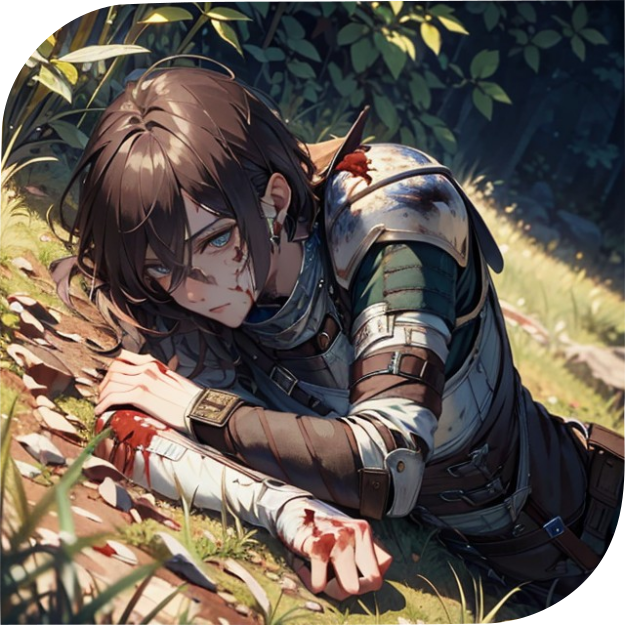
At 0 HP, a character concedes defeat. At 0 HP, the character: 
  • Is knocked unconscious until brought above 0 HP or 1d6 hours (at which point they gain 1 HP)
  • Ends all special effects or actions they were sustaining
  • Ends all status effects which a Save could normally end

​If the source of damage was non-lethal (as from a club or fist), the above is all that happens.
​However, if the source of damage was lethal (as from a sword or spell), the character: 
  • Gains the Wounded status
  • Gains a random Trauma (see below)
  • Takes one Strain each time they: 
    • Take damage
    • Start a turn Wounded (until Stabilized)

Endurance

Endurance are temporary Hit Points that go "on top" of a character's normal pool of HP. When you take damage, subtract from any available Endurance before losing your normal Hit Points.

Sara has 20 HP and a magical barrier providing her with 5 Endurance. An attack hits her for 7 damage. She loses all 5 Endurance, then 2 points from her normal pool of HP, reducing her to 18 total HP.

Endurance doesn't transfer between Scenes. When a Scene ends, all Endurance is lost. Points of Endurance can't be restored or added onto; if new points of Endurance are received while you still have some old points of Endurance left, the new instance of Endurance overwrites the old one (or you may simply forego receiving this new instance of Endurance altogether). 

Sara's barrier is giving her 5 Endurance. Her ally Pau casts a spell that would give Sara 3 Endurance. She can either replace her 5-Endurance barrier with this new 3-Endurance effect or forego receiving this new instance of Endurance. She would not have 8 Endurance because old instances of Endurance are not cumulative with new ones.

HP Debt

Even after reaching 0 HP, a character's HP can dip into the negative numbers. In this state, a character can't regain consciousness until their "HP Debt" is paid off. Any instance of healing helps to "pay off" these negative numbers. There are also certain items and special abilities which may also help in this regard. Any damage the character accumulates while unconscious puts them further "in debt", however.

Unconscious characters who have been medically stabilized (either by an instance of healing, a medical feat, or a special item/ability) recover 1 HP every 1d6 hours, so a character's HP Debt may be paid off on its own in time.

Example: 
Roche has 3 HP and takes 10 points of damage. This not only reduces him to 0 HP, but incurs 7 points of HP Debt (because 3 - 10= -7).

Losing Hit Points

When a character is hit by an enemy attack, triggers a trap, or suffers from some other hazard, they will most likely lose Hit Points. A character may lose more or less HP depending on whether they have Vulnerability or Resistance to the incoming type of damage (see the Combat section for more information damage Vulnerability and Resistance).
Picture

At 0 HP

You are defeated; your HP can dip into negative numbers, incurring "HP Debt"

All special effects you were sustaining end

All the status conditions currently affecting you end

You lose consciousness until you are brought up to at least 1 HP

Determine whether the damage
was Non-Lethal or Lethal ​(see right)
Picture

Non-Lethal Damage

The damage was not intended to kill you and came from blunt force (like a fist or club) or an otherwise non-lethal weapon

If this is the case, stop here

Picture

Lethal Damage

The damage was intended to kill, maim, or otherwise cause you great harm

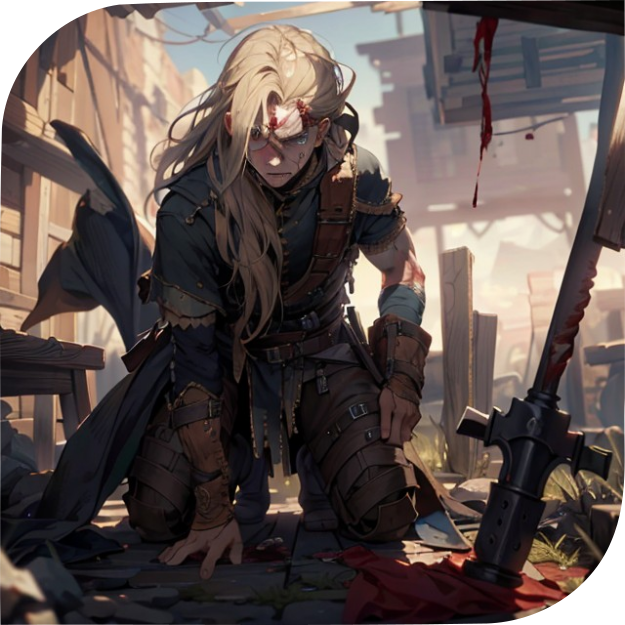
You gain the Wounded status and are now standing at death's door

You suffer a random Trauma (see below)

Take one Strain every time you take damage (remember that your HP can dip into negative numbers and you won't awaken from unconsciousness until you have at least 1 HP)

Until Stabilized, you take one Strain every time you begin your turn Wounded
A Wounded creature can be Stabilized by: 
  • Any instance of healing that restores HP (even if this does not bring them above 0 HP)
  • Special abilities and items that automatically stabilize a Wounded creature
  • Receiving medical aid (this is an Action which requires an Intellect Feat and medical tools)
While you are unconscious at or below 0 HP: 
  • You recover 1d6 HP every 6 hours
  • You recover HP equal to the number of Bumps rolled on an Intellect Feat to administer medical aid (this can occur once per day)
A Wounded creature dies when they start their turn with maximum Strain.

recovering hit points

Hit Points are typically recovered by spending Resolve; a pool of dice that reflects your inner strength, stamina, and resilience. When you're allowed to roll Resolve, you may roll the amount indicated and recover HP equal to the combined total of all dice rolled. You don't get Resolve you roll back until the end of your next Full Rest. Your Resolve dice may start as d6s or d8s but can change in size as you grow stronger. Regardless, you'll always roll this size of dice when you spend Resolve.
Picture

Take a Rest

When you take a Full Rest (6+ hours of uninterrupted sleep), you'll recover all your lost Hit Points, awkening with 100% HP.

You can also take a Short Rest (of at least 15 minutes) to take a breath and collect yourself. For every 15 minutes spent in a Short Rest, you can roll your Resolve dice to recover HP.
Picture

Roll Resolve

You have a special Resolve dice which you can roll to recover lost Hit Points equal to the number rolled. 

You'll only be able to roll your Resolve when taking a Short Rest or when prompted to by an ability, item, or other special circumstance.
Picture

Special Items or Abilities

Some abilities and special items can also restore HP or allow you to roll Resolve and recover extra HP in addition to what you'd normally roll.

​Such abilities and items are uncommon and a precious resource that should be carefully managed through the course of a long adventure.

Trauma

When a creature is Wounded, their player rolls 1d20 and consults the chart below to see what Trauma befalls them. This effect remains in play until the creature heals from the Trauma.
ROLL
TRAUMA
1
Death: You die instantly
2
Brush with Death: Roll 1d6 and add your Save score. If the total is less than 6, you die instantly.
3
Hanging By a Thread: If you are Wounded​ again before healing this Trauma, you die instantly.
4
Broken​: You have Disadvantage on all attack rolls.
5
Infection: Your Physical Vulnerability increases by 1 now and it increases by 1 again each time you complete a Full Rest without healing from this Trauma.
6
Open Wound: Reduce the size of your Resolve dice by 1 degree.
7
Cracked Skull: You are Staggered.
8
Fractured Bone​: You have Disadvantage on all Feats that reference Brawn or Skill.
9
Concussion​: You have Disadvantage on all Feats that reference Intellect or Awareness.
10
Nasty Bruise: You have Disadvantage on all Feats that reference Charisma.
11
Damaged Eye: You are Blinded.
12
Internal Bleeding: You cannot recover Hit Points.
13
Shell-Shoked: You are Dazed.
14
Head Trauma​: You cannot remove Strain.
15
Chronic Pain: You have Disadvantage on all Saves.
16
Coughing Up Blood: You are Silenced.
17
Wrenched Leg: You are Slowed.
18
Wrenched Arm: You are Weakened.
19
Lucky​: You don't suffer any Trauma at all.
20
Miracle: Not only do you suffer no Trauma, you instantly Stabilize.

Recovering From Trauma

Every time you take a Full Rest, roll a Save.
​Once you've accumulated a total of 5 Bumps (even if it takes you multiple Full Rests), you recover from a Trauma of your choice.

If your Trauma has been medically treated, these Saves have Advantage.

STATUS CONDITIONS

Characters can suffer from various status effects that significantly affect their performance. For as long as the condition is active, its effects persist. Status conditions are typically indicated in rule descriptions using ​italics.

POSITIVE CONDITIONS

Haste: Your speed and reflexes are greatly increased.
While Hastened you: 
  • Start your turn with +1 Actions.
  • Increase your Speed by 1.

Hidden: You are concealed from view.
While Hidden you: 
  • Have Advantage to act against those you are Hidden from
  • Cannot have Line of Sight drawn to you
  • Are revealed after making an attack or otherwise drawing attention to yourself

Intangible: You are immaterial.
While Intangible you: 
  • Can pass through solid objects and creatures
  • Cannot take damage
  • Cannot deal damage or interact with that which is tangible

Invisible: You cannot be seen.
While Invisible you: 
  • Have Advantage to act against those who cannot see you
  • Cannot have Line of Sight drawn to you
  • May be momentarily detected, but cannot be fully revealed until the effect that's making you Invisible ends​

SAVE ENDS

Every effect has a different duration (which should be listed alongside whatever caused the effect), but a Save can usually end a Status Condition.

Roll to Save at the End of Your Turn
Once per round when your turn ends, you may roll your Save to end a status condition that a Save can end.

Save Difficulty = Level of the Effect's Origin
The Difficulty of a Save is equal to the Level of the character (or trap or other effect) that it originated from.

​Save Bumps are Cumulative
Bumps you roll to Save against a Status Condition are cumulative; if you don't roll enough this round, you're that much closer to ending the condition when you Save at the end of your next turn.
​
Karis is Frozen in place by the spell of an ice wraith. She resists with all her heart and soul as her body ices over, making a Save to free herself. The ice wraith is Level 8, meaning Karis will need a total of 8 Save Bumps to end this effect. Karis rolls 5 Bumps and remains Frozen, but only needs to roll 3 more Bumps to break free.

​Shielded: You are invincible.
While Shielded you: 
  • Negate the next instance of damage you'd suffer or
  • Negate the next negative status condition that would affect you
  • This condition ends after negating one instance of damage or one status condition

Regenerating: You rapidly recover vitality.
While Regenerating you: 
  • Recover a set amount of HP at the start of your turn each round
  • The amount of HP recovered is described with the effect causing Regeneration (usually in parenthesis)

NEGATIVE CONDITIONS

Blinded: You cannot see.
While Blinded you: 
  • Provide Advantage to attackers
  • Have Disadvantage on rolls +Awareness
  • Automatically fail actions where vision is necessary to succeed

Charmed: Your mind is controlled.
While Charmed you: 
  • Act under the direction of the one that is charming you during your turn
  • Cannot spend Mana or any other important resource
  • Have half as many Action Dice as you normally would
  • May Save to end the condition any time you take damage (even if a Save wouldn't normally end the condition)

Confused: Your mind is scrambled.
While Confused you: 
  • Provide Advantage to attackers
  • Must flip a coin when your turn starts.
    • If heads, you may take your turn normally.
    • If tails, you do nothing during your turn but mutter and stumble around uselessly.

Dazed: You lose immediately lose Concentration and are unable to use Reactions.
While Dazed you: 
  • Cannot maintain Concentration
  • Cannot take Reactions
  • Provide Advantage to attackers

Deafened: You cannot hear.
While Deafened you: 
  • Are unable to hear anything
  • Have Disadvantage on rolls +Awareness
  • Automatically fail actions where hearing is necessary to succeed

Fixated: You are compelled to attack a certain foe.
While Fixated you: 
  • Are compelled to attack the enemy you are Fixated on
  • Have Disadvantage on attacks that do not include the enemy you're Fixated on as a target
  • Immediately end this condition if the enemy you're Fixated on
    • Becomes Hidden or Invisible
    • Leaves the Scene or is removed from play
    • Is reduced to 0 HP

​Frozen: You are frozen solid in a block of ice or otherwise locked in stasis.
While Frozen you: 
  • Are immune to damage
  • Cannot move or be subjected to forced movement
  • Cannot roll or spend Action Dice (except to Save)

Immobilized: You cannot move from your current position.
While Immobilized you: 
  • Cannot move on your own volition (you may still be subjected to Forced Movement)
  • May still perform other actions that don't require moving from your current position
  • You can still teleport or be teleported while Immobilized

Ongoing Damage: You rapidly lose vitality.
While taking Ongoing Damage you: 
  • Lose a set amount of HP at the start of your turn each round
  • The amount of HP lost is described with the effect causing Ongoing Damage (usually in parenthesis)
  • Ongoing Damage cannot be reduced, negated, or ignored

Prone: You are lying on the ground.
While Prone you: 
  • Provide Advantage to melee attackers
  • Ranged attacks have Disadvantage to hit you
  • Have Disadvantage with melee attacks
  • Move at half Speed

Silenced: You cannot use special abilities.
While Silenced you: 
  • Lose any instance of Concentration you are maintaining
  • Cannot spend Mana
  • Cannot speak above a whisper (if at all)

Slowed: You are slowed down.
While Slowed you: 
  • Reduce your total Speed by 2 (to a minimum of 1)

Staggered: You are knocked off-balance.
While Staggered you: 
  • Reduce your total Actions by half
  • Provide Advantage to attackers

Stunned: You're knocked senseless.
While Stunned you: 
  • Cannot use Actions or Reactions
  • Provide Advantage to attackers
  • End the Stunned effect the instant you take damage

Terrified: Fear grips your heart.
While Terrified you:
  • Cannot spend Focus
  • Provide Advantage to attackers
  • Cannot voluntarily move closer to the source of your terror

Unconscious: You are asleep.
While Unconscious you: 
  • Cannot move, act, or react at all
  • Are Prone (unless artificially propped up)
  • Provide Advantage to attackers

Weakened: You are physically weaker.
While Weakened you: 
  • Reduce the total damage you inflict by 50% (including bonus damage)
  • Do not reduce damage from a creature's Vulnerability

Wounded: You are dying.
When Wounded you: 
  • Immediately fall unconscious until brought to 1 HP (your HP can dip into negative numbers)
    • ​You recover 1d6 HP every 6 hours while unconscious
    • If treated medically (once per day), you recover HP equal to the Bumps rolled in the required Intellect Feat
  • Suffer a random (roll 1d20) Trauma
  • All powers, effects, and actions you are sustaining end
  • Take one Strain every time you take damage while Wounded
  • Take one Strain at the start of your turn each round until you Stabilize
    • ​You are Stabilized by special items, a medical Feat, or any instance of healing (even if it doesn't bring you up to 1 HP)
  • Die if you start your turn with maximum Strain

HOME

HOW TO PLAY

SETTING

CHARACTER

ADVENTURE

Copyright © 2023
  • Home
  • How to Play
  • Setting
    • AfterLight
    • Belhaven
  • Character Creation
    • Species
    • Backgrounds
    • Assets
    • Features
    • Foils
    • Class >
      • The Berserker
      • The Cantor
      • The Dread
      • The Engineer
      • The Esper
      • The Exorcist
      • The Hallowed
      • The Hunter
      • The Magus
      • The Monk
      • The Occultist
      • The Sage
      • The Scoundrel
      • The Verdant
      • The Warrior
  • Adventure
    • Arms and Equipment